taking charge of your learning

There is no shortage of individuals who have created entirely different careers compared to where they started:
- Chip Wilson, founder of Lululemon and widely credited with creating the “athleisure” retail category, started his career in an oil company but remained deeply curious about how to develop functional yet stylish sports clothing
- Nisha Katona, founder of Mowgli, an Indian street food chain in the UK, became a restauranteur following a 20-year career as a full-time barrister, in pursuit of her passion for food
- Nicola Elliott, founder of Neom Organics, trained as an aromatherapist and nutritionist after she became concerned about her own well-being in her hectic job as a magazine journalist
- Tara Swart, neuroscientist, top-tier leadership coach and award-winning author, started her career as a medical doctor
These entrepreneurial moves were driven by deep interest in making things better. They did not start off knowing how to design sports clothing or how to run a business, but they remained so curious about these areas that they spent hours learning how to do it well.
Many of the most rewarding jobs today involve doing things that did not even exist when the people doing them were still in school. The prescribed paths are crumbling away. It has never been more necessary and less risky to pursue areas that you have deep interest in to remain relevant in the future of work.
To do so, we must learn how to learn.
What skills do we need? What level do I need to learn that skill to? How urgently do I need to learn this skill? How do I learn best?
Learning requires us to maintain a beginner’s mindset. We do not need to know it all. We only need to distinguish between what we know, and what we do not know.

When you know where things go, how they fit together, and why, then learning can accelerate.
Once we are motivated to learn something new, and have mastered the basics, we can hone our skills through deliberate practice.
Deliberate practice involves deconstructing a method, analysing which parts you want to improve, then building on what works until you are as good as you want to be.
For example, when I was learning to edit videos, I had to pay attention to pace of speaking, the story of a piece of music, the quality of lighting and graphics for the visual components, among others. By filming a short segment, I could prioritise which areas I wanted to improve and deliberately practise them.
Practice can take three forms[1]:
- Education: Learning through structured courses and programmes
- Exposure: Learning with and through others (e.g. coaching, networking)
- Experience: Learning through day-to-day activities and challenges
The nature of the skill, and the level of mastery we seek will influence how much time and energy we devote to these areas.
Let’s examine this further.
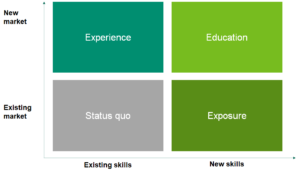
As the framework below shows, we can diversify skills in three main directions:
- Apply existing skills in new markets (i.e. areas where there is demand)
- Develop new skills and apply them to existing markets
- Develop new skills and apply them to new markets
New skills in new areas: Education
To learn new skills in new areas, you will most likely need some formal training to understand basic concepts that you can then apply.
In my first years at university, I focused on mainly quantitative techniques to solve defined problems. I then chose to progress to techniques to frame and address more complex problems, where conflicting objectives across multiple stakeholders made it difficult to define the problem. These were mostly qualitative in nature. This led to further research in combining these techniques to create resilience and flexibility.
New skills in existing areas: Exposure
Here, the assumption is that you have foundational skills, but you may want to expand your repertoire. It’s like cross-training, where you deliberately engage in other exercises to get better at your core.
They may seem strange and even silly, but this element of creative flair may also inject fresh motivation to improve existing skills in existing areas. For example, when I wanted to learn how to adapt my writing style to be less academic and more appealing to a wider audience, I took a public speaking course. I began to record myself, which helped me to refine my writing based on my spoken word.
Existing skills in new areas: Experience
When you are just beginning to learn something, you focus on mastering the building blocks. As you improve, you build on what works, and begin to look at what might stop you from meeting your goal.
Applying existing skills in new areas to you may mean that you bring a fresh perspective to those who have been working in an area for some time. In a supportive environment, questioning the way things are done can trigger ideas for improvement.
When I was approached to take on a role in talent management, I didn’t initially think I had the deep expertise as some of my peers who built their careers specifically in this space would have had. However, my existing skills in strategic thinking, analytics and commercial acumen were critical to success. There was a belief that I could learn more technical aspects quickly, in contrast to these skills which were harder to acquire. The most efficient and effective way to apply my existing skills to new areas was through experience.

Learning how to learn
The reality for us all is that due to higher life expectancy, we will also work longer. The pace of technological and social change means that we can expect many ‘new normal’ situations in our lifetimes. Given that many jobs of the future do not yet exist, we must take responsibility for our own learning.
We are likely to learn best and fastest when we are deeply curious about a topic. What matters is to be deliberate about what you are trying to learn, why, and to have a plan of action to build your repertoire.
Developing a range of skills is critical to adapting in the new world of work. This will require a mix of formal training, exposure and experience. To allocate your time and energy appropriately, it helps to be clear on whether you want to enhance existing skills, build new skills, and whether you want to apply them to existing or new areas.
[1] This is known as the 70:20:10 model of learning, which advocates that in order to learn complex skills, roughly 70% of effort should be allocated to experience, 20% to exposure, and 10% to education.