How to learn in the new world of work

taking charge of your learning

There is no shortage of individuals who have created entirely different careers compared to where they started:

  • Chip Wilson, founder of Lululemon and widely credited with creating the “athleisure” retail category, started his career in an oil company but remained deeply curious about how to develop functional yet stylish sports clothing
  • Nisha Katona, founder of Mowgli, an Indian street food chain in the UK, became a restauranteur following a 20-year career as a full-time barrister, in pursuit of her passion for food
  • Nicola Elliott, founder of Neom Organics, trained as an aromatherapist and nutritionist after she became concerned about her own well-being in her hectic job as a magazine journalist
  • Tara Swart, neuroscientist, top-tier leadership coach and award-winning author, started her career as a medical doctor

These entrepreneurial moves were driven by deep interest in making things better. They did not start off knowing how to design sports clothing or how to run a business, but they remained so curious about these areas that they spent hours learning how to do it well.

Many of the most rewarding jobs today involve doing things that did not even exist when the people doing them were still in school. The prescribed paths are crumbling away. It has never been more necessary and less risky to pursue areas that you have deep interest in to remain relevant in the future of work.

To do so, we must learn how to learn.

What skills do we need? What level do I need to learn that skill to? How urgently do I need to learn this skill? How do I learn best?

Learning requires us to maintain a beginner’s mindset. We do not need to know it all. We only need to distinguish between what we know, and what we do not know.

When you know where things go, how they fit together, and why, then learning can accelerate.

Once we are motivated to learn something new, and have mastered the basics, we can hone our skills through deliberate practice.

Deliberate practice involves deconstructing a method, analysing which parts you want to improve, then building on what works until you are as good as you want to be.

For example, when I was learning to edit videos, I had to pay attention to pace of speaking, the story of a piece of music, the quality of lighting and graphics for the visual components, among others. By filming a short segment, I could prioritise which areas I wanted to improve and deliberately practise them.

Practice can take three forms[1]:

  • Education: Learning through structured courses and programmes
  • Exposure: Learning with and through others (e.g. coaching, networking)
  • Experience: Learning through day-to-day activities and challenges

The nature of the skill, and the level of mastery we seek will influence how much time and energy we devote to these areas.

Let’s examine this further.

As the framework below shows, we can diversify skills in three main directions:

  • Apply existing skills in new markets (i.e. areas where there is demand)
  • Develop new skills and apply them to existing markets
  • Develop new skills and apply them to new markets
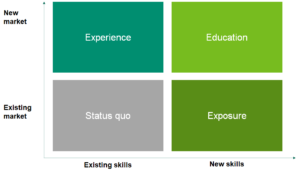
New skills in new areas: Education

To learn new skills in new areas, you will most likely need some formal training to understand basic concepts that you can then apply.

In my first years at university, I focused on mainly quantitative techniques to solve defined problems. I then chose to progress to techniques to frame and address more complex problems, where conflicting objectives across multiple stakeholders made it difficult to define the problem. These were mostly qualitative in nature. This led to further research in combining these techniques to create resilience and flexibility.

New skills in existing areas: Exposure

Here, the assumption is that you have foundational skills, but you may want to expand your repertoire. It’s like cross-training, where you deliberately engage in other exercises to get better at your core.

They may seem strange and even silly, but this element of creative flair may also inject fresh motivation to improve existing skills in existing areas. For example, when I wanted to learn how to adapt my writing style to be less academic and more appealing to a wider audience, I took a public speaking course. I began to record myself, which helped me to refine my writing based on my spoken word.

Existing skills in new areas: Experience

When you are just beginning to learn something, you focus on mastering the building blocks. As you improve, you build on what works, and begin to look at what might stop you from meeting your goal.

Applying existing skills in new areas to you may mean that you bring a fresh perspective to those who have been working in an area for some time. In a supportive environment, questioning the way things are done can trigger ideas for improvement.

When I was approached to take on a role in talent management, I didn’t initially think I had the deep expertise as some of my peers who built their careers specifically in this space would have had. However, my existing skills in strategic thinking, analytics and commercial acumen were critical to success. There was a belief that I could learn more technical aspects quickly, in contrast to these skills which were harder to acquire. The most efficient and effective way to apply my existing skills to new areas was through experience.

Learning how to learn

The reality for us all is that due to higher life expectancy, we will also work longer. The pace of technological and social change means that we can expect many ‘new normal’ situations in our lifetimes. Given that many jobs of the future do not yet exist, we must take responsibility for our own learning.

We are likely to learn best and fastest when we are deeply curious about a topic. What matters is to be deliberate about what you are trying to learn, why, and to have a plan of action to build your repertoire.

Developing a range of skills is critical to adapting in the new world of work. This will require a mix of formal training, exposure and experience. To allocate your time and energy appropriately, it helps to be clear on whether you want to enhance existing skills, build new skills, and whether you want to apply them to existing or new areas.


[1] This is known as the 70:20:10 model of learning, which advocates that in order to learn complex skills, roughly 70% of effort should be allocated to experience, 20% to exposure, and 10% to education.


Cutting through an uncertain job market

An uncertain job market

There are times when the job market is thriving. Individuals often have their pick of roles that make use of their strengths and offer opportunities to growth in a variety of companies.

Then there are times when the job market is less lucrative, and choices seem limited. Individuals often feel compelled to take roles that provide short-term cash flow, even if they might not offer opportunities to advance.

Regardless, COVID-19 created a highly uncertain job market. According to the World Economic Forum, if the economic shutdown lingers for many months, or if serious pandemics become a recurring phenomenon, there will be profound, long-term consequences for the reallocation of jobs, workers, and capital across firms and locations.

Two out of every five jobs lost during COVID-19 may not come back.

How can we navigate this less familiar landscape?

Be the go-to for something

Whether it’s a manager reviewing a CV, or you’re introducing yourself at an interview, or someone is reading an article you published, anyone consuming or receiving information from you is looking for a hook. How can he/she help me or my team?

You can make this easy for them by being clear about what you are the go-to person for. What do people usually ask you for help with? What do people recommend you for? When work colleagues introduce you, what do they say? What type of work do you love doing?

This will shape the type of work you choose to do, and with whom. It will also allow you to attract the people you want to your work. Similarly, being clear on what you bring to the table helps you to seek out like-minded people.

For instance, my career history involves designing initiatives to help organisations future-proof their strategy.

People have come to me to help them with design of corporate education programmes in decision making under uncertainty, and the future of work. They recommend me for project management and thought leadership.

I have used this to frame my role as helping leaders to envision ways in which they can leverage their human capital to grow their business in the face of rapid change.

Showcase learning agility

When roles are scarce or fluctuating, employers are less inclined to take risks. They are likely to be on the lookout for specific characteristics, such as a track record at a certain level in a specific sector.

The danger of this approach is that what made someone successful in the past is not a reliable predictor of what will make them successful in future.

Savvy employers seek out those with a track record of being able to learn and deliver quickly, and those with diverse connections in their network.

An example of this is Kabir Seghal, who has been a US Navy Reserve officer, author, and record producer, among other things. In a Harvard Business Review article, he describes how working many jobs left him more fulfilled, and helped him perform better at each job.

For example, his corporate role subsidised record producing and taught him the skills required to succeed in the music business. By exposing his clients to musicians, he was able to differentiate himself and make interesting yet pertinent connections.

Create what excites you

Malcolm Gladwell, New York Times bestselling author and host of the Revisionist History Podcast, was initially unable to get a job in advertising, so launched a career in journalism, harnessing his curiosity in compelling ways.

Similarly, Simon Sinek, a renowned speaker and author, led a marketing consultancy that started to struggle after a few years. In an Entrepreneur interview, he says, “When I was able to stop lying, hiding and faking, and was able say, ‘I’m really good at this, really bad at that, ‘people came from all over [saying], ‘Oh, I could totally help you with that.'”

His first book deal was not the result of building a platform, but spending less than half an hour with an editor, explaining his idea and why it mattered. The editor took a chance on him.

In short, cutting through a noisy job market requires you to be memorable.

You can do this by sharing your intense interest in a topic and how it can positively influence the status quo, making unlikely but valuable connections across different networks and concepts, or shaping a clear narrative on what you are the go-to for.

There is no guarantee that people will remember you, but these are tangible ways to influence how they remember you.

Three things you can do now to thrive in the future of work

What is the future of work?

If you asked ten different people what they understood by the term “future of work”, you would probably get ten different answers.

Put simply, the future of work is the term used to describe the technological, social and environmental trends that will shape what works looks like and how it gets done.

Technology

Rapid developments in artificial intelligence (AI), automation, quantum computing, and analytics are reinventing the way humans interact with machines.

Automation will lead to jobs being reconfigured as intelligent machines take on activities traditionally done by humans. For example, a lorry driver in future may not be responsible for driving the lorry, but for coordinating the route of a set of lorries based on weather, traffic and energy efficiency data.

Artificial intelligence may enable us to train machines in some of our skills, and lead to new forms of human-machine interaction.

Sougwen Chung, an artist, has been able to use publicly available footage of New York City as well as images of her drawings to teach a robot her artistic style. This has led her to make art in new ways through human-robot collaboration.

Similarly, Icelandic pianist/composer Ólafur Arnalds continues to experiment with technology to play piano notes faster and use robots to make patterns that are unnatural for human physical instinct and provoke new ideas.

Social

From a social perspective, as life expectancy increases, pension contributions as they existed in the past won’t be enough to support us. Most of us will need to work till later in our lives to fund retirement, and to combat loneliness and depression.

New family structures, including the rise of dual income couples who take extended breaks to develop new skills or interests, or to look after elderly relatives, will also drive new ways of independent and collaborative work.

Environmental

Greater awareness of climate change and youth activism around the issue alongside investor attitude towards sustainable, ethical practices will also influence new forms of collaboration. While unclear, the balance across global, regional and country frameworks to address cyber-security, national security and worker mobility will also influence relative attractiveness of places to live and work.

So what?

Why should the average worker, or to-be worker, be concerned about these developments? First, it is no longer reasonable to assume that careers will progress in linear ways.

A recent McKinsey report found that knowledge-intensive and creative occupations are the largest and fastest growing segments of the freelance economy.

This is driving a shift from being in work, where presenteeism, meeting well-defined performance targets and tenure drive progression and stability, to being at work, where the discipline to regularly and efficiently generate products or services that find a market drive a sense of personal fulfilment.

Even those outside the freelance economy are being encouraged to take an entrepreneurial approach to their career. This is because the traditional organisational hierarchy is being replaced by networked teams, where those with relevant expertise come together to deliver defined projects then disperse.

To raise the chance of being selected for projects over time, individuals must similarly develop a strong reputation in areas that matter most to the organisation in order to progress.

Second, the employee-employer contract is evolving. Employees in future may be inclined to rely less on employers for security, growth and development, and more inclined to see them as partners in driving positive societal change.

The 2019 Edelman Trust Barometer revealed that nearly 60 percent of employees are looking to employers to help them navigate information, particularly in areas where there are many credible voices, where misinformation is rife, and where employers can play a role in positive change.

This has evolved at a time when governments and the media have consistently failed to meet expectations. As a result, workers who align themselves to employers who share their values and actively support causes that matter to them individually may have a more fulfilling experience at work.

The third implication for individuals is developing their capacity to renew skills and reinvent themselves over the course of a longer working life. The rapid evolution of technology and the freelance economy mean that the scope of the role that a human may occupy will also change.

By engaging with evolving technology, individuals can play a proactive role in reshaping where and how they can add value to a company. This is in stark contrast to sensationalist headlines about robots taking human jobs.

What can you do today to prepare for the evolving future of work? Here are three suggestions:

Use routines to energise

When we expect that changes will occur throughout the course of our career, we can tune in to the routines we have today that help us to feel a sense of order and control despite uncertainty.

This is not about trying to control situations. It is about understanding the people and things that reliably energise us, helping to sustain us during more difficult times.

Whether these routines involve meditation, exercise, time with friends, pets or travelling, make time for these.

Similarly, reduce time spent on activities or people that drain energy.

Leverage your network

Anticipate disruption by exploring those people in your immediate or second order network who may have valuable information about how your industry or role may be evolving.

Ask questions on how jobs are being reconfigured (e.g. permanent to contract, automation of tasks) , new partnerships or alliances in the industry, salary projections, and lateral movements.

These can provide valuable signals to you on how you can leverage your skills in new ways, or invest in learning more to remain relevant and thrive.

Connect your work to a broader purpose

Historically, many people have taken on jobs to pay the bills. Yet it will be increasingly important to be able to articulate how the activities you undertake connect to a sense of purpose, as a way to help yourself and others understand where and how you can add value.

This does not entail months of self-reflection in solitude but can take the form of micro-reflections.

After every project or interaction, note what worked well for you and where you could have done differently. Notice the environment and the people you were working with and what aspects energised or demotivated you. These provide valuable clues on how you can position yourself to consistently do your best work.

How to identify values in action

Values as a catalyst

Black Panther is the fourth-highest-grossing superhero film of all time. When Bob Iger, then-CEO of Disney, placed the Black Panther movie on the must-do list of Marvel projects because he thought it represented great storytelling, not everyone was enthusiastic.

Skeptics were concerned that films with predominantly black casts would struggle in international markets. Bob stood by his decision to make a great movie and not to fall prey to old arguments about what the world should be. 

In a letter sent to all employees after the movie’s opening week, Bob writes, “The movie’s success is also a testament to our company’s willingness to champion bold business and creative initiatives, our ability to execute an innovative vision flawlessly, and our commitment to bringing extraordinary entertainment to a world that is hungry for heroes, role models, and unbelievably great storytelling.”

His commitment to telling great stories helped him to go against convention and demonstrate how much he was willing to sacrifice. Telling great stories acted as a rallying cry for employees and other stakeholders. And it set new standards in Hollywood.

How can we become more aware of our values, or what matters most to us? How can we live our values through the choices and actions we make?

Here are three things to reflect on:

When I do my best work, who/what surrounds me?

A 2017 paper in Management Science showed that the best quality job leads, determined by the interview and job offer conversion rate, came from those with strong relationships among those in their network.

The stronger the relationship the more likely that a contact would be a stronger advocate in the hiring process by going beyond a referral for a job interview, to make follow up calls or provide recommendations to those hiring.

This emphasises how important it is to put yourself in situations that enable you to do your best work. When you can do work that matters to you in an environment that values your effort, you are more likely to drive positive outcomes as you put in more effort to make a difference.

In turn, those you work with are more likely to strongly recommend you to like-minded people they are connected with, which in turn creates and sustains the conditions you need to do high quality work.

If something is important to me, what am I willing to give up?

Values evolve, particularly as circumstances change.

For example, when we start earning an income, we might value freedom from depending on others for financial support. Promotion or inheritance may lead us to place a greater value on long-term financial security, investing for ourselves and others. Divorce, ill health or bereavement may upend the value we place on financial security, in favour of time spent with loved ones.

In a similar way, we may accept a lower salary in the short term if it offers opportunities for growth in income over the long term. For example, taking role that pays less may allow us to learn entirely new skills, build broader networks or invest in monetising a creative idea. Assessing these trade-offs helps to clarify just how much an aspect matters to you.

What do I observe in society that I would like to be a part of changing?

Judge Thokozile Masipa, well-known for her role in the trial of Paralympic champion Oscar Pistorius in South Africa for the murder of his girlfriend, started her career as a journalist. She saw a lot of injustice in the courts when covering the Soweto uprising in 1976 and turned her talents to directly fighting it instead of exposing it. So began her shift from journalism to law. She remains one of the most respected senior female judges in the country.

Thokozile made a conscious choice to devote her energy to playing at a higher level. Like Bob Iger, she decided that she wanted to be part of changing widely accepted norms.

Our values help us to take concerted action. They make it easy to let go of the things and people that no longer serve us well, and to focus on surrounding ourselves with the people and things that are aligned to our goals.

How to remain relevant in the future of work

Rapid shifts are underway in the jobs market

It’s estimated that two-thirds of children entering primary school today will ultimately end up working in jobs that do not yet exist. When you consider that, it helps us understand just how work is changing and will continue to change in the years ahead.

The acceleration to digital as a consequence of a global pandemic is also forcing many companies to reposition themselves. Either they can try to go into new markets or develop new capabilities.

Companies can struggle with these transitions. The consultancy Bain found that when a company positions itself further from its core capabilities, the chances of success quickly drop, to just 5%. For employees this can mean they are more likely to lose their jobs. This creates yet more instability and that’s becoming the new norm surprisingly quickly.

In the UK, in 2016, just one in twenty working-age adults worked on ‘gig economy’ platforms. Today that number is one in ten.

In the US, one in five reported earning some money from the “digital platform economy” in 2016.

For these reasons, it is no longer reasonable to assume that knowledge and skills that we master in earlier years can last an entire career, or that a career is likely to focus of one area of expertise.

Think like an entrepreneur

Given these developments, it is imperative that individuals adopt an entrepreneurial approach to their career. This can take various forms.

An individual’s value will increasingly depend on the value they can create for users in the system they are a part of.

This creates a natural talent marketplace, where several people bid for projects with clear outcomes. Individuals come together to deliver the mission, then dissipate after the project is over. This process creates competition and fuels entrepreneurship as individuals position themselves with the skills and experience to deliver on projects.

According to research by Michael Watkins, author of Master Your Next Move: The Essential Companion to The First 90 Days, a typical leader today with 18 years’ experience would have made a transition on average every 18 months. This could take the form of promotion, a move between business units, or a geographic move.

With increasing life expectancy, higher average retirement age and lower government pension provisions, these transitions can be expected to accelerate. The ability to handle multiple transitions and to anticipate disruptions will set future leaders apart.

Research by Harvard University, the Carnegie Foundation and Stanford Research Center in 2015 all concluded that 85% of job success comes from having well-developed soft and people skills, and only 15% from technical skills and knowledge (hard skills).

While knowledge and skills are relatively easy to verify, the signal of soft skills tends to be reputation. In an instant demand world, perception matters. The ability to portray a sense of who you are and what you can contribute through extracurricular activities, volunteer experience and your network will be increasingly important.

In order to remain relevant throughout one’s career, continuously positioning how one can bring value, demonstrable ability to change direction and commercialising new opportunities outside one’s core skill set will be critical.

Learning the way forward

Remaining relevant in the future of work is foundational for today’s professional. The aspiration should be to adapt to thrive in the future of work.

The first step towards this is to take an outside-in approach. Understand the forces shaping the future of work , how the context in which your current role exists may be changing. Imagine which activities that comprise your role today may be automated or outsourced in the next 1, 3 and 5 years. Explore what activities you remain uniquely qualified to undertake.

The next step would be to take an inside-out approach. Reflect on what your key strengths are, and what other types of activities you can apply them to. Examine which industries or types of companies are interested in your key strengths. Research the career profile and trajectory of those with similar strengths to you for inspiration. Build a map of possible future roles.

Then you can truly begin to learn your way forward in your career. Of the roles that resonate most, ‘try on’ a few of them. Speak to those doing the job today and those who they work with, and get a sense of how they see it evolving. If possible, collaborate with them on a small piece of work. Find small ways to advise. Reflect on what these interactions tell you about the things that matter most to you.

Eventually, the next best move will become clear to you. First, you must act in the direction of your future.

Simple questions that generate huge possibilities

Feelings influence beliefs


Many start January with goals to get fit, lose weight or be more active. Yet, according to research by Strava, billed as the world’s largest sports participation platform, within a few weeks of starting an exercise regime, people quit. Dubbed Quitter’s Day, the fateful date was 17 January in 2019. It was 19 January for 2020.

After-work fatigue, invitations for after-work or weekend events, and January blues can all lay claim to a failure to persistare all blamed for why many end up giving up on these goals.

It is easy to blame outside factors for a failure to persist, when in. In fact, our own thoughts and fears are usually the root cause.

The more we think about something, the more intensely we feel it. The more we focus on certain thoughts, the more they take control.

In the case of fitness, the more we think about the pain of physical activity, especially if it is less unfamiliar to us, the less likely we are to take actions associated with pain.

Similarly, the more we think about the joy of fitting into new clothes, the overall sense of well-being we may feel if we persist, the more likely we are to take actions associated with these feelings.

How we feel

Our feelings influences what we believe will happen. When we entertain negative feelings, such as those associated with pain, loss and guilt, we are motivated to prepare for the worst that can happen.

In contrast, when we engage with feelings associated with joy, gain and progress, we prepare for the best that can happen. Both are possible in any given moment.

One restricts us, and the other moves us closer to what we want.

Believing in a positive future creates possibility

ClassPass, a studio fitness and wellness platform was started by Payal Kadakia in 2013.

In January 2020 it became a , ‘Unicorn’ – a start-up valued at $1billion.

The journey started when Payal went to a friend’s birthday in 2010. At the party she was inspired by the people she met, some of whom were building apps full time .

She gave herself two weeks to think of an idea.

A day and a half after she got back from the party, she was having trouble finding a suitable ballet class. Instead of getting frustrated, she began to explore: “What if I could build a search engine for classes?”

Her belief that she could create something of use to her and many others triggered a life-changing journey.

Onwards

We are unlikely to achieve what we hope for in our first attempt.

Yet, persistence grounded in exploring what is possible allows us to ask, “What can I do differently next time?”

For example, ClassPass originally started as Classivity in 2010, as an OpenTable for class schedules. It generated interest but clients did not book. This led to Passport in 2012, which allowed users ten chances to try one class at a new studio.

When they found classes they loved, they started using fake emails to return.

This led to another version in 2013. This iteration resulted in a $99 per month membership for an unlimited number of classes, but just three classes a month in the same studio.

This membership gave people enough time to try out new classes.

Continuously testing and learning highlighted opportunities to accelerate progress and remove obstacles.


Another uplifting story comes from a Harvard Business Review article on professional transitions.

It describes the evolution of Judith’s career from partner in accounting firm to partner in a venture capital fund.

Judith began to organise reading groups for those interested in Judaism. By speaking with more people, she realised that she was limiting her sense of possibility by believing that she could not do anything new.

She began to investigate moving to venture capital, an area that leveraged her skills but one she never previously considered as she thought the work was repetitive.

Within six months she started as a senior analyst, and within two years, she was offered a partnership.

Draw on diverse experiences


Sometimes, embracing possibility requires us to draw on our different experiences and networks to make connections that may not be obvious.

Lynda Gratton is a London Business School professor who is well-known for her work on the changing nature of work and its implications. She has evolved her career by starting from an academic background, moving to Chief Psychologist at British Airways.

She then moved to PA Consulting, and to Assistant Professor at London Business School. It would have been unusual, back in the 1980s, to make transitions like this.

Yet, she credits her varied background with helping her to develop a distinctive approach that helps others to evolve professional experiences that span traditional boundaries and that capture individual needs in and outside work .

We may wait for a set of right conditions that may never come.

In order to achieve our goals, it is more helpful for us to accept that nothing stays the same.

When we deliberately ask questions like, “What if..” , “What is the next best move?” and “What can I do differently next time?”, we trigger feelings and actions based on what is possible. In so doing, we nudge ourselves to keep moving forward.